The Many Thalis of India
To understand India, eat a thali in five different states. The word means "plate" — but a thali is really a whole philosophy served all at once.
The short version
- A thali is a balanced platter of many small dishes eaten together — a chord, not a single note.
- Each region has its own: sweet Gujarati, royal Rajasthani, banana-leaf Tamil, seasonal Bengali.
- Underneath every thali is the same instinct: feed the guest generously, and balance every taste.
To understand India, eat a thali in five different states. The word simply means "plate," but a thali is really a whole philosophy served at once: a circle of small bowls arranged so that every bite can be a different balance of sweet, salty, sour, spicy, bitter and astringent. It is not a course; it is a chord — designed so that no single flavour dominates and no diner leaves hungry.
West: sweet Gujarat, royal Rajasthan
In Gujarat, the thali arrives sweet and gentle — soft rotli, dal with a hint of jaggery, shaak, kadhi, and a farsan on the side, refilled endlessly whether you ask or not. In Rajasthan, it turns rugged and royal: dal-baati-churma, gatte ki sabzi, ker sangri, ghee poured without apology — food built for a desert, where fresh vegetables were scarce and richness meant survival.
South: the banana leaf
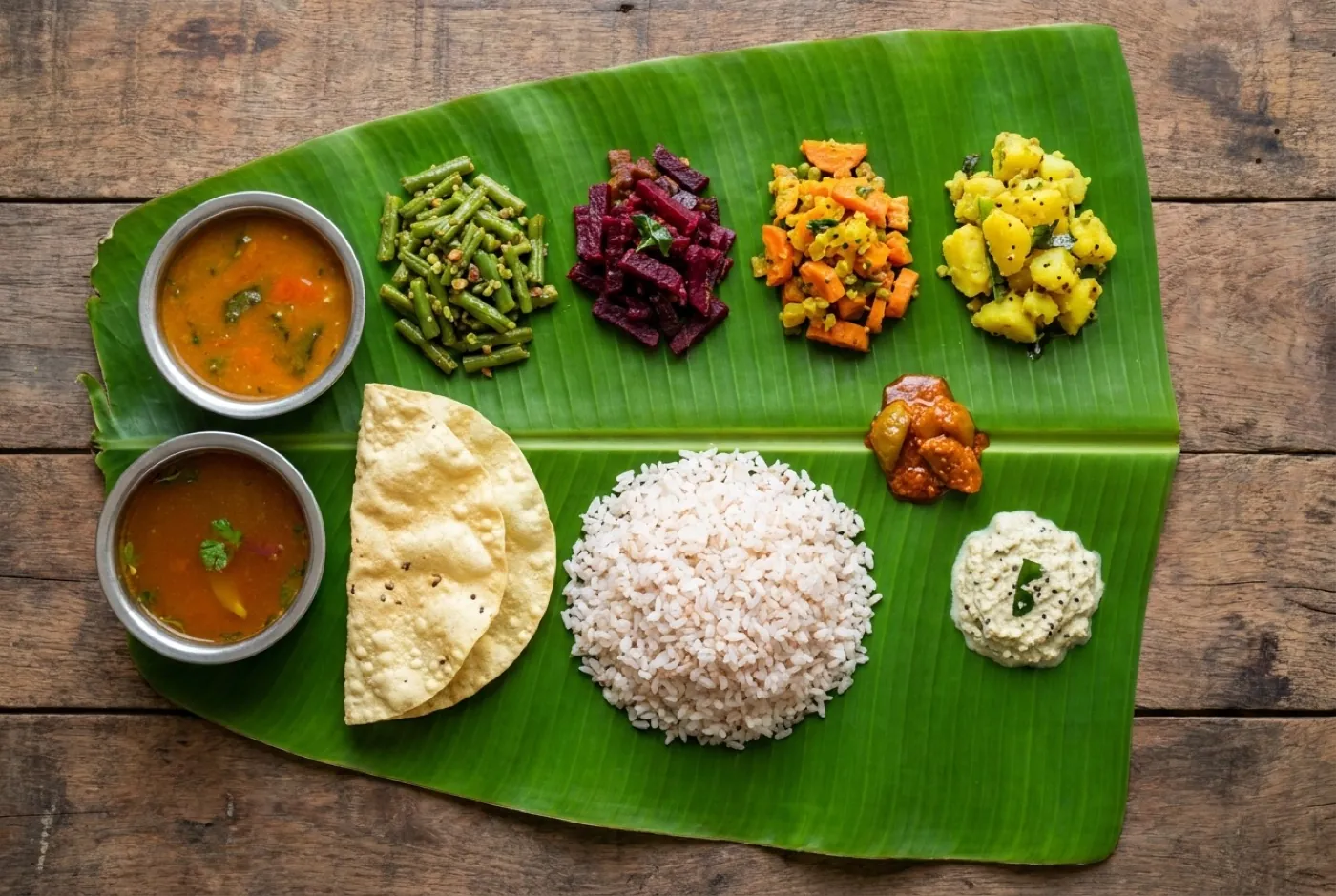
Travel south and the Tamil meals thali unfurls on a fresh green banana leaf — rice, sambar, rasam, a series of poriyals and kootus, a crackle of appalam, pickle, and curd to cool the finish, eaten by hand in a precise, generous order that ends with sweet payasam. The leaf itself lends a faint fragrance, and there is nothing to wash up.
A thali is India's table manners made edible: a little of everything, and no one goes hungry.
East: the seasons of Bengal
In Bengal, the plate follows the seasons and the rivers — shukto, a gently bitter medley, to begin; then dal, then fish in mustard, then a sweet to end, because a Bengali meal without mishti is simply unfinished. Even the order is choreographed: bitter first to wake the palate, sweet last to close it.
The same quiet instinct
Five thalis, five climates, five histories. And underneath them all, the same quiet Indian instinct: feed the guest first, feed them well, and feed them more than they can finish. A thali is not just a meal; it is a worldview on a plate — that life is best experienced as a little of everything, in balance, together.
Common questions
What is an Indian thali?
A thali is a platter holding many small dishes — dal, vegetables, rice, bread, yoghurt, pickle and often a sweet — eaten together so each mouthful balances different tastes. It's a complete, balanced meal in one plate.
How is a Gujarati thali different from a South Indian thali?
A Gujarati thali leans sweet and mild with rotli, dal, shaak and farsan, and is famously unlimited. A South Indian (e.g. Tamil) thali is typically served on a banana leaf with rice, sambar, rasam, poriyals and curd, and is more tangy and rice-centric.
Why is a thali served on a banana leaf?
Banana leaves are traditional in South India because they're natural, hygienic and lend a subtle aroma to hot food. They're also eco-friendly and need no washing — the leaf is simply composted afterward.